Learning how to automate affiliate reviews with AI comes down to deciding which stages a tool handles and which ones stay with you. If you publish in evenings and on weekends, you have a few hours a week, and every one of them should go to work only you can do. The stages below show where AI saves time and where a person has to sign off before a review goes live.
Why a pipeline beats prompting from scratch each time
Starting every review with a blank chat window means re-explaining your tone, your audience and your standards each time. The AI fills the gaps with its defaults, and the defaults are why so many reviews read alike: the same “game-changer” adjectives, the same balanced-sounding pros and cons, the same verdict that commits to nothing.
A pipeline fixes the inputs. The voice guide, the research brief format and the section prompts are written once and reused. Each review then differs only in the product facts and your hands-on notes, which is where the differences between reviews ought to be.
It also makes publishing steady. When each stage has a clear start and finish, you can do one stage in a 45-minute evening slot and pick up the next one two days later without rereading everything. If you want the argument for where AI belongs in review writing at all, AI vs human written affiliate reviews covers it. This article is about the mechanics.
Stage 1: Build a voice guide your AI drafts must follow
A voice guide is a one-page document you paste into every drafting session. Keep it concrete. “Friendly and professional” gives the AI nothing to work with, because every tool already assumes that.
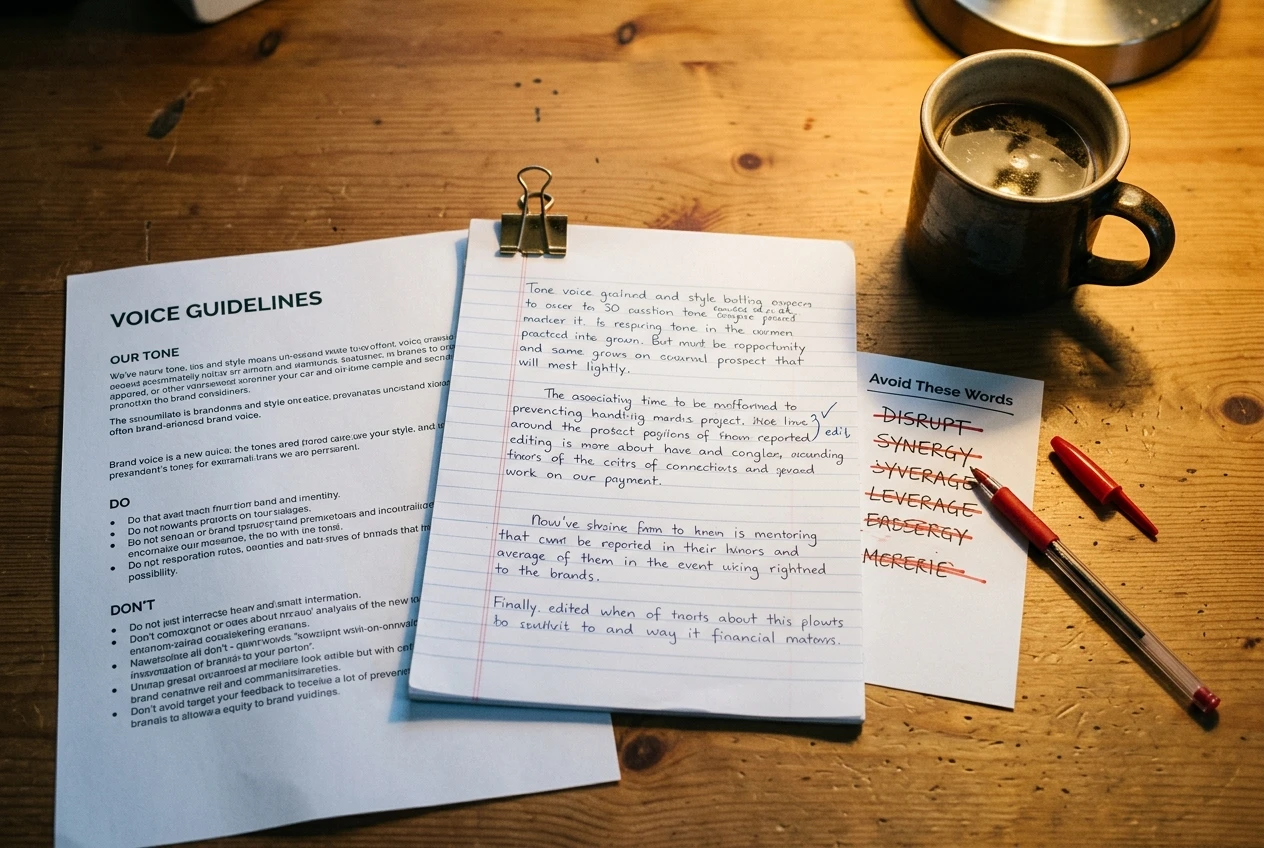
Include these items:
- Point of view. Who is speaking, and who is being spoken to. For example: second person, addressing someone with limited time who is weighing a first purchase.
- Sentence habits. Average sentence length, whether you use contractions, whether you ask the reader questions.
- Words to use and words to avoid. Keep a short banned list: hype words, filler openers, anything you would never say out loud.
- How you handle downsides. For instance: every review names at least one real limitation and says who it matters to.
- Claims you never make. For this site, that means no income promises and no guarantees of results.
- Two or three paragraphs of your own writing. These are the most useful part. The AI imitates examples far better than it follows adjectives.
Write the guide once, then revise it after your first few drafts. Whenever you catch yourself rewriting the same phrase in an AI draft, add a line to the guide so you stop fixing it by hand.
Stage 2: Turn each product into a research brief before any drafting
Drafting straight from a product name invites the AI to guess at features, prices and plan limits. A research brief puts the facts on the page first, so the draft has something real to work from.
A brief for one product should hold:
- The product name, the company and the exact page or pages you pulled facts from.
- Current pricing and plan names, copied from the official pricing page on the day you checked.
- The three to five features that matter to your reader, described from the vendor’s documentation.
- Who the product suits and who it does not.
- Two or three alternatives worth mentioning.
- The affiliate program terms: commission structure, cookie window and any restrictions on how you may promote it, taken from the program’s own pages.
- The keyword the review targets and what the searcher most likely wants to know.
- Blank slots for your hands-on notes, to be filled in Stage 4.
AI is useful here for organizing material you supply. Paste in the pricing page text and the feature documentation, and ask it to sort them into the brief format. Do not ask it to recall prices or plan limits from memory, because those change and it cannot see today’s page.
Stage 3: Draft in sections, not in one giant prompt
One prompt asking for a 2,000-word review produces a smooth, generic result. The model drifts away from your guide as the text gets longer, and if one part is weak you have to regenerate everything.
Draft one section at a time instead. A typical review breaks into these:

- Opening and who the product is for
- What it does and the features that matter
- Pricing and what each plan includes
- Strengths and limitations
- Alternatives
- Verdict and who should buy
For each section, give the AI your voice guide, the relevant part of the brief, and a short instruction such as “write the pricing section in 150 to 200 words, using only the figures in the brief.” Restricting it to the brief reduces invented details.
Shorter outputs are also easier to judge. You can read a 200-word section in a minute and see whether it sounds like you. Replacing one weak section costs a single prompt, and the other five stay as they are.
Stage 4: The human pass that AI cannot do
This stage is the reason the review is worth publishing. Nothing a tool drafts can contain what you did with the product, because the tool has not done it. This pass covers three things.
Hands-on notes
Add what you actually observed: what the setup involved, which feature you used most, what confused you, what you would tell a friend before they bought. Only write what is true. If you have used the product, put your real notes in the slots from Stage 2. If you have not, say so plainly and frame the review as an analysis of the vendor’s documentation and public information. Readers forgive a clearly labeled research-based review. They do not forgive one that implies experience it lacks.
Honest downsides
AI drafts tend to soften limitations into “may not suit everyone.” Replace that with the specific thing: the plan that lacks a feature the reader will probably want, the learning curve, the price jump at a higher tier. A named downside makes your recommendation believable, and it saves the reader from a purchase that would leave them disappointed.
Disclosure
Make sure the review tells readers you earn a commission if they buy through your link, in plain words near the top and before the first link. Link to your full affiliate disclosure page so the details live in one place. Check this in every review, every time. A template can place the disclosure automatically, but a person should confirm it is actually there.
Stage 5: Fact-check and edit against a short checklist
Once the draft has your notes in it, read it once against a fixed checklist. A checklist keeps the check fast, which matters when you have 30 minutes. It also stops you from skipping steps on the evenings you are tired.

A workable version:
- Every price, plan name and limit matches the official page, checked today.
- Every feature claim traces to the vendor’s documentation or to your own use.
- No sentence promises a result, an earnings figure or a timeline.
- The commission terms mentioned match the program’s current terms.
- Each affiliate link goes to the right product page and works.
- The review names at least one real limitation and says who it affects.
- The disclosure appears before the first affiliate link.
- Nothing in the voice guide’s banned list appears in the text.
- The opening paragraph tells the reader what they will learn and who the review is for.
AI can do part of this. Paste the finished draft and the brief, and ask it to list every factual claim in the draft that the brief does not support. Treat its answer as a list of places to look. You still open the source pages and confirm each one yourself.
Stage 6: Publish with a repeatable template and internal links
A template removes formatting decisions. Build one layout for reviews with the same heading order, the same place for the disclosure, a quick-summary box near the top, and a consistent spot for the pros and cons. Formatting is a good job to hand to AI: give it the finished text and the template, and have it return the article in your site’s structure.
Then add internal links by hand, or by checking its suggestions against your own pages. Each new review should link to related pieces a reader would plausibly want next, such as a comparison or a guide to choosing between tools. A reader of a keyword research tool review, for instance, may want your breakdown of SEMrush vs Ahrefs for affiliate marketing. Add links only where they help the reader, and give each target page one link at most per article.
It also helps to track each review’s current stage on a simple board: brief done, sections drafted, human pass done, checked, published. ClickUp vs Notion for running an affiliate review pipeline compares two tools for that, and a spreadsheet works too. What matters is that you can see at a glance which stage each review is waiting at.

Stage 7: Schedule refresh checks so old reviews do not go stale
A published review keeps making claims about prices, features and commission terms, and those change without notice. A review with last year’s pricing costs you reader trust, and an affiliate link to a retired plan sends readers somewhere confusing.
Set a recurring check, and give each review a “last verified” date in your tracker. A reasonable rhythm is to look at your most-visited reviews more often and the rest less often. Pick intervals you will keep, such as every quarter for the top reviews and twice a year for the others.
A refresh check has three parts:
- Open the official pricing and feature pages and compare them with the review.
- Test the affiliate links and confirm the program terms have not changed.
- Update anything that differs, then change the verified date.
AI helps with the comparison. Paste the current page text next to your review text, and ask it to list every difference in price, plan name or feature. You still decide what to change and you make the edit. Also refresh a review right away when you hear of a major product update, a pricing change or a change to the affiliate program.
What to automate first if you only have a few hours a week
You do not need all seven stages running at once. Build them in the order that returns the most time for the least setup.
- The voice guide and the brief template. These take one sitting each and improve every review after them.
- Section-by-section drafting. Once the first two exist, this is where most of the hours come back to you.
- The checklist and the publishing template. These make the last mile quick and consistent.
- Refresh checks. Add these once you have a handful of published reviews to maintain.
Keep the human pass in every review, whatever else changes. If your week is short, publish fewer reviews rather than skipping it. A smaller library of reviews with real notes and honest limitations serves readers better than a larger one of polished generic drafts. For help fitting this into an actual week, a weekly schedule for building an affiliate site after 5pm shows how to divide limited evenings.
Results vary from person to person and no workflow guarantees traffic or earnings, but a repeatable process makes it much easier to keep publishing, and publishing consistently is the part within your control.
If you want to build this pipeline with your Writer and a Hub to keep it organised, you can join Wealthy Affiliate through our link and start with a single review run end to end before scaling up.