
If you’re working out how to build an affiliate business while working full time, the question that matters most is how to run each week. Motivation fades and timelines slip, but a schedule you can repeat after a draining Tuesday keeps a site moving. This article gives you one: a weekly system built on 5 to 8 protected hours, split into four kinds of work, with a rule for what to drop when your job gets busy.
It makes no promises about earnings. A schedule cannot tell you what a site will pay, only whether the site gets built.
Why a 9-5 is a better starting position than it feels like
Evenings and weekends feel like a handicap next to someone with all day to work on a site. A full-time job does give you advantages, though.
- You don’t need the site to pay this month’s bills. That lets you pick topics for the long term, write something useful instead of something rushed, and ignore the pull of tactics that promise fast money and rarely deliver it.
- Your hours are predictable. A fixed work schedule makes it easy to place recurring blocks on the calendar, and recurring blocks are what produce a finished site.
- You can pay for tools without strain. Hosting, keyword research and a decent writing setup cost money, and a paycheck covers them without pressure.
- Your job may already give you something to write about. Many workplaces teach project management, software, finance, health, or a trade. If one of those overlaps with a niche, you start with vocabulary and credibility that others have to build.
The cost is that your hours are limited and your energy at the end of the day is lower. The schedule below is designed around that.
Find your real hours: an honest audit of one ordinary week
Most people plan around the hours they wish they had. Start with the hours you actually have.
Take one ordinary week, not a holiday week and not the quietest one you can remember. Write down every fixed commitment: work, commuting, meals, family, exercise, sleep, errands. What remains is your pool of available time. Then mark each open window by how much energy you usually have in it.

Look for three things:
- Windows of 60 to 90 minutes or longer. Writing and research need unbroken stretches. Four 20-minute gaps rarely add up to one useful session.
- Your best energy slot. Put writing there. Many people find that a weekend morning or an early start works better than the hour after dinner, but your own audit decides this.
- Low-energy windows. These suit lighter tasks such as formatting a post, adding internal links, or checking a draft for errors.
Aim for 5 to 8 hours a week. Five hours is two weeknight sessions and one longer weekend block. Eight hours is the same pattern with one more weeknight session and a longer weekend. Fewer than five hours can work, but progress will be slow enough to test your patience. Put the sessions in your calendar as appointments with a start and end time, because a block you only intend to find time for tends to disappear.
The four blocks: research, write, publish, improve
Every hour of site work fits into one of four blocks. Naming them keeps you from drifting into whatever feels most comfortable, which for most people is fiddling with the site design.
Research
Research covers choosing the topic, checking what readers search for, looking at what currently ranks, and gathering the facts you need. For a review or comparison post, it also means working out what you can honestly say about the product. Do this in a batch: one session can plan several articles, so your writing sessions start with a ready brief instead of a blank page.
Write
This is the largest block, and it should get the most hours and the best energy. A draft means a full article with real detail, not a stack of notes. Keep research and writing in separate sessions, since switching between them mid-session slows both.
Publish
Publishing means more than pressing a button. It includes editing the draft, adding a title and meta description, setting headings, adding images, inserting affiliate links and the required disclosure, linking to your other posts, and checking the page on a phone. It is a good low-energy task, because the thinking is done and the work is a checklist.
Improve
Improving means returning to posts you already published: fixing unclear sections, updating prices and features that have changed, adding questions readers ask, and tightening titles that don’t attract clicks. For the first month or so there is little to improve, so the block stays small. As your library grows, it becomes more important, because an updated post can be worth more than a new one.
A reasonable starting split is about 15 percent research, 55 percent writing, 15 percent publishing, and 15 percent improving. Adjust it as the site matures: more improvement time and less new writing once you have a decent number of posts.
A sample week for 5 hours and another for 8
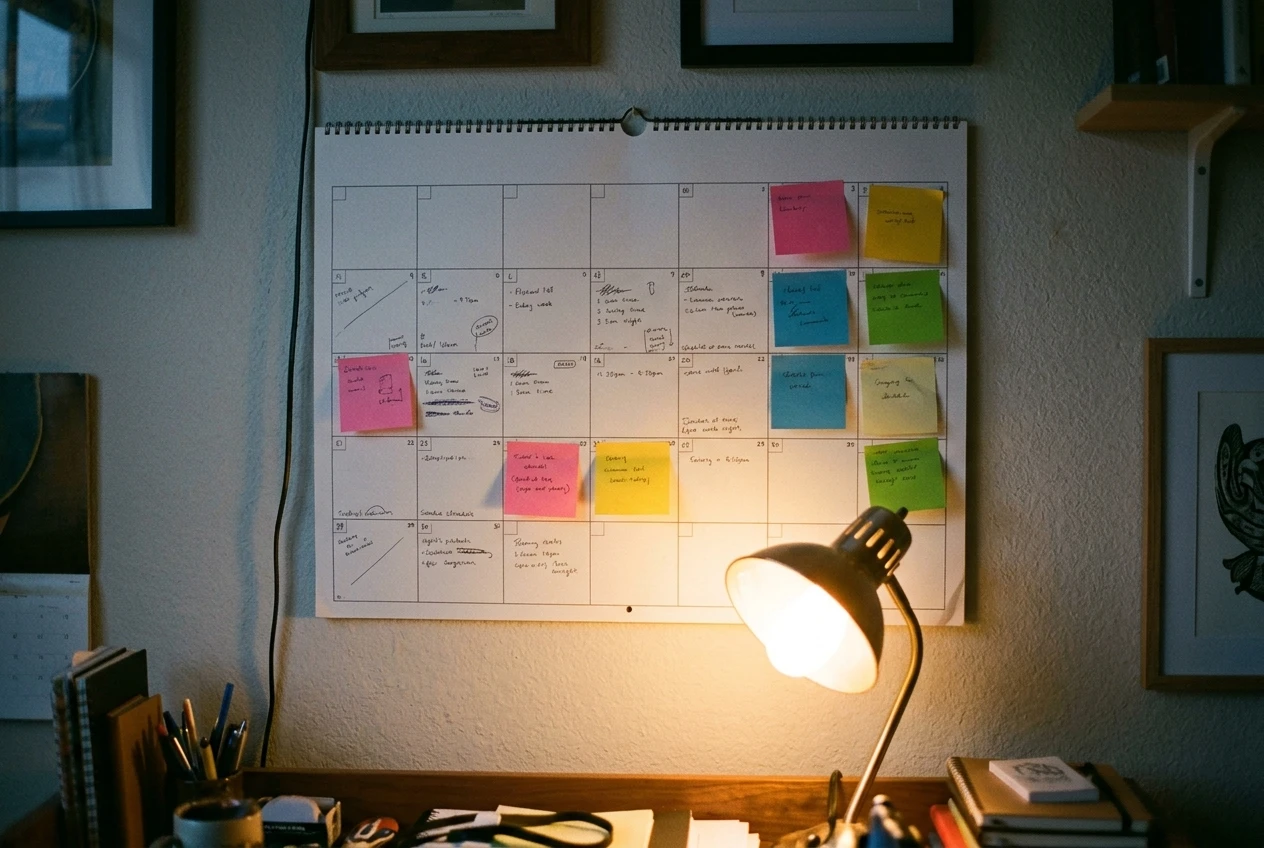
These are templates, so move the days around to fit your audit.
The 5-hour week
- Monday, 60 minutes: research. Pick next week’s topic, collect sources, and outline the article.
- Wednesday, 90 minutes: write. Produce most of the draft.
- Saturday, 150 minutes: 60 minutes to finish the draft, 45 minutes to publish it, and 45 minutes to improve an older post.
That is one new article a week, plus a little maintenance. Total: 5 hours.
The 8-hour week
- Monday, 60 minutes: research. Outline the next two articles.
- Tuesday, 90 minutes: write. Draft article one.
- Thursday, 90 minutes: write. Finish article one and start article two.
- Saturday, 120 minutes: 45 minutes to publish article one, and 75 minutes to improve older posts.
- Sunday, 120 minutes: write. Finish the second draft, ready to publish early next week.
This pace produces one to two articles a week with a steady improvement habit. Total: 8 hours.
Notice that in both versions the publish and improve blocks sit in the weekend, when you have longer windows, and the research block sits in a short weeknight slot. Research can be done in smaller bites than writing, so it fits better in a tight evening.
Where AI drafting saves time and where you still do the work
With limited hours, AI assistance is useful, but it helps with some tasks and not others.
Where it saves time:

- Turning a keyword and your notes into an outline.
- Producing a first draft that you then rewrite and correct.
- Suggesting title options, meta descriptions, and FAQ questions.
- Rephrasing a clumsy paragraph or shortening a long one.
- Summarizing your own research notes so you can write from them.
Where you still do the work:
- Facts. Prices, features, plans and limits change, and a draft can contain details that are wrong or out of date. Check each one against the product’s own page before you publish.
- Your judgment. A review is only worth reading if it says who the product suits and who should skip it. That opinion has to come from your own research and reasoning.
- First-hand claims. Write only what you have done. If you haven’t used a product, say you are summarizing its published features and the experiences others report, and don’t imply you tested it.
- Disclosure and compliance. Affiliate disclosures and any rules from the program you’ve joined are your responsibility.
- Voice. A draft left untouched sounds like every other draft. Edit it until it sounds like a person with a point of view.
A sensible workflow is to let AI handle roughly the first draft in your writing block, then spend the rest of that block editing and checking facts. For a fuller process, see how to use AI to scale affiliate product reviews.
What to cut first when work gets busy
Some weeks your job will take everything: a deadline, a project launch, a stretch of overtime. Decide in advance what goes, so you don’t make the call while exhausted. The rule is to cut from the end of the list first and protect the writing session.
Drop things in this order:
- Tool tinkering and design changes. Themes, colors and menu layouts can wait indefinitely.
- New research beyond the next article. Work only on the topic you are about to write.
- The improve block. Old posts can sit unchanged for a few weeks without harm.
- A second weekly article, if you were publishing two.
- The publish block, only if you must. A finished draft can wait a few days.
Protect one thing: a single writing session of 60 to 90 minutes. An unwritten article produces nothing and cannot be improved later, while updates can usually wait. If even that session is impossible, keep a floor for the week: 30 minutes on an outline or a few paragraphs. A short week keeps the habit alive, and a skipped week makes the next one harder to start.

Once the busy period ends, return to the full schedule at the next Monday research block. Don’t try to make up the lost hours by doubling the following week, because that is how people burn out on a side project.
If you want the longer view of why many beginners stop, why most affiliate beginners quit in year one covers the common patterns.
Reading your first 90 days without chasing quick income
At roughly one article a week, 90 days gives you somewhere around a dozen published articles. A new site is usually still being discovered by search engines at that point, so judge it on what you control instead of on earnings.
Useful measures for the first 90 days:
- Output. Did you keep to the schedule most weeks? Consistency is the main thing this period tests.
- Publishing quality. Is each post complete, accurate, and clearly useful to a specific reader?
- Indexing. Are your pages showing up in Google Search Console, and are they being crawled?
- Early search signals. Which queries produce impressions, even with few clicks? These show which topics deserve a follow-up post or an update.
- Reader questions. Comments, emails, and the questions that keep recurring suggest what to write next.
Commissions in this window can be small or absent, and that does not mean the plan has failed. It means the site is young. If you are weighing how long the full journey might take, the realistic timeline for replacing a 9 to 5 income covers it. This article stays with the weekly routine.
At the end of 90 days, do a short review. Keep the blocks that worked, move the ones you kept skipping to a better time slot, and decide whether 5 or 8 hours is the right number for the next quarter.
Spend your limited hours on content
When your time is limited, every hour spent assembling tools is an hour not spent on research, writing, publishing, or improving. See how Wealthy Affiliate puts site building, hosting, keyword research and writing support in one place, so your evenings and weekends go into producing content for your site.