
Running one affiliate site teaches you a lot about picking a niche and writing content that converts. Running three teaches you something different: how much a single domain can actually hold before it starts working against itself. If you’re asking yourself should I run multiple affiliate sites, the honest answer is that it depends on whether your first site has hit a ceiling yet, and most people don’t realize it has until they try to publish something that doesn’t fit.
This site, apexaffiliate.org, and affiliatesnipers.com each exist because a single site couldn’t serve every reader I wanted to reach without confusing the ones already there. Here’s how that split actually works, and where it doesn’t make sense to copy it.
The ceiling a single affiliate site eventually hits
Every affiliate site is built around a voice and a reader intent, whether or not the person running it set out to design one. This site is for people comparing tools and networks before they commit, people who want a clear answer to “Impact or PartnerStack” or “SEMrush or Ahrefs” before they spend money. That reader wants depth, comparisons, and a calm, informative tone.
That same reader is not the person looking for a fast list of which affiliate programs pay out this month, or someone who already knows the tools and wants aggressive takes on which ones are overhyped. Writing both into one site means one of two things happens. Either the tone gets diluted until it serves neither reader well, or the site starts to feel disorganized, like it can’t decide what it’s for.

Search engines pick up on that too. A site that tries to rank for careful comparison content and fast-moving trend content at the same time sends mixed signals about what it’s authoritative on. Topically focused sites tend to outperform scattered ones, because both readers and search engines reward a site that clearly knows what it covers.
That’s the ceiling. Not a traffic number, not a revenue number: a point where adding more topics to one site stops helping that site and starts working against it.
How I decided where to draw the lines between the three sites
The split isn’t about having three shots at the same goal. It’s about matching each site to a distinct stage of reader intent, so a visitor lands on the one built for where they actually are.
Some readers are early: they’re deciding whether affiliate marketing is worth their time at all, or they’re choosing their first niche and platform. Others are past that. They already have a site running and want to know which tools to add or which network pays better for what they’re selling. A third group isn’t researching at all; they want to know what’s worth acting on right now.
Drawing the lines between those groups, rather than between topics or niches, is what keeps the three sites from overlapping. Two sites covering “affiliate marketing” broadly will eventually compete for the same keywords and the same reader. Two sites covering different stages of the same reader’s journey won’t, because nobody searches both “how do I start affiliate marketing” and “best affiliate deals this week” on the same day.
What apexaffiliate.org covers that this site deliberately doesn’t
This site stays focused on the comparison and workflow layer: which tool, which network, which platform, and how to build a review pipeline that doesn’t eat every hour you have. It’s built for someone still assembling their setup.
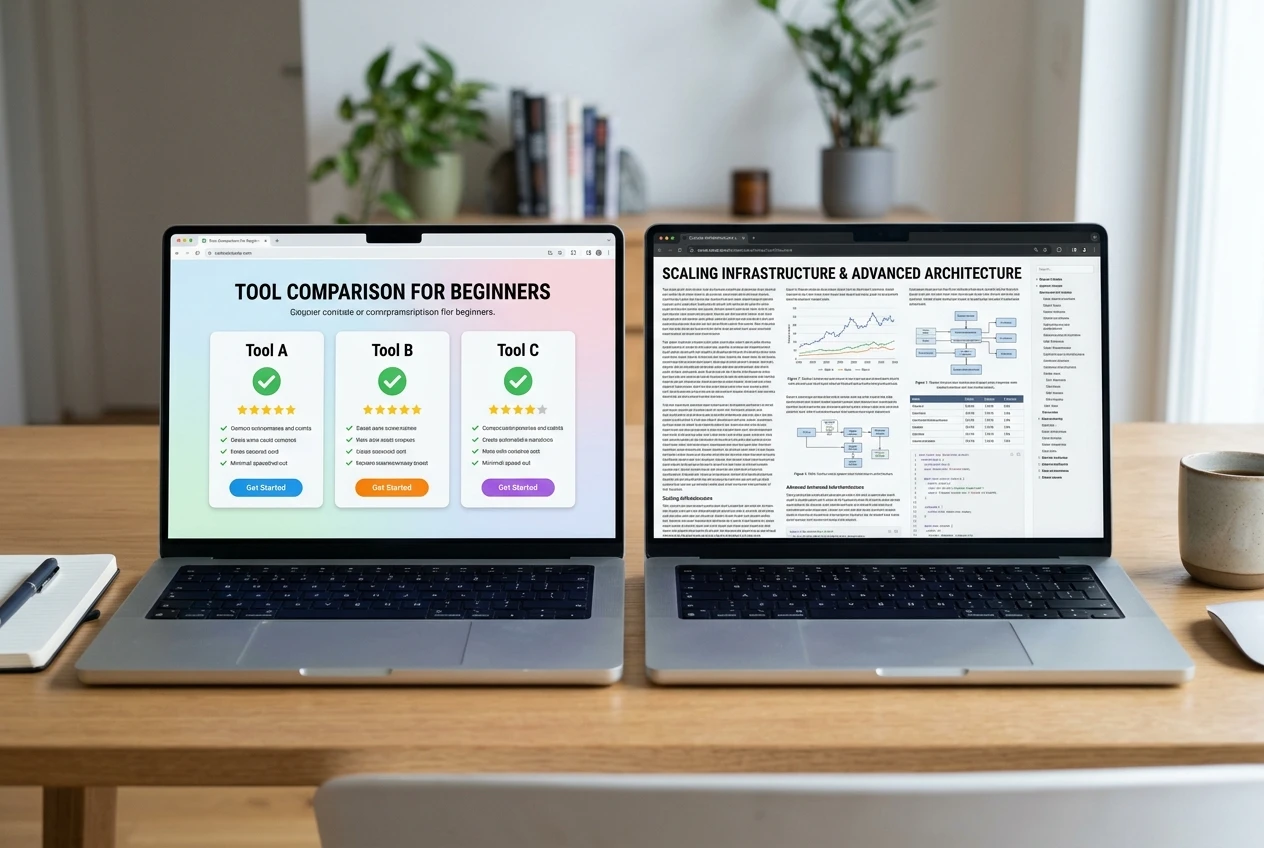
Apexaffiliate.org picks up past that point. It’s aimed at the reader who already has a site generating some traffic and wants to go deeper into scaling it: negotiating better terms with networks, structuring content for authority rather than just coverage, and the kind of decisions that only come up once a site has some history behind it. That content would sit awkwardly here, next to posts aimed at someone still deciding where to start, because it assumes a level of traction this site’s typical reader hasn’t reached yet.
Keeping that separation means neither site has to hedge its advice to cover two different audiences at once. This site can stay beginner-friendly without talking down to anyone. Apexaffiliate.org can go deeper without losing a reader who isn’t ready for it yet.
Where affiliatesnipers.com fits into the mix
Affiliatesnipers.com covers the part neither of the other two sites is built for: time-sensitive content. Which programs are worth applying to right now, which commission structures are shifting, which tools are running promotions worth acting on before they expire. That kind of content ages fast and needs a publishing rhythm that doesn’t fit a site built around evergreen comparisons.
Mixing fast-moving, here-today-gone-next-week content into a site meant for long-term comparison posts creates a strange reading experience. A visitor comparing SEMrush and Ahrefs doesn’t want to scroll past a post about a deal that expired weeks ago, and it drags down the credibility of the evergreen content sitting next to it. Separating the two lets each site stay clean for what its reader actually came for.
How traffic moves between the three without it reading as a link scheme
Cross-linking three sites you own can look fine or look manipulative depending entirely on whether the link serves the reader or serves the sites. The test is simple: would this link make sense if the two sites were owned by different people?

When this site’s reader has outgrown the comparison-level content here and is ready for the scaling-focused material apexaffiliate.org covers, pointing them there is a genuine service. The same logic applies the other direction: apexaffiliate.org’s advanced reader who skipped the fundamentals benefits from being sent back to the groundwork here. Those links exist because the reader’s need changed, not because the sites need the traffic exchange.
What doesn’t work is linking for the sake of linking: stuffing a reference to another site into a post where it doesn’t fit, or linking back and forth between all three on every page to pad internal link counts. That pattern is easy to spot, both for readers and for search engines, and it does more damage to trust than the traffic gain is worth. The rule that keeps it honest is linking only when the content on the other end is genuinely the next thing that reader needs.
The workflow that keeps three sites from turning into three full-time jobs
Three sites with three separate ad hoc workflows is a fast way to burn out. The part that actually makes this manageable is running all three through one shared system for planning, drafting, and tracking content, rather than treating each site as its own operation with its own process.

That means one place to see what’s queued across all three sites, one pipeline for drafting and editing before anything gets published, and one way of tracking which posts are actually converting so decisions about where to spend time are based on something real rather than a feeling. Without that, it’s easy to spend a week heavily on one site simply because it’s the one open in a browser tab, while the other two go quiet.
If you’re weighing tools for that kind of pipeline, ClickUp vs Notion for Affiliate Marketing walks through what each one handles well when you’re running more than a single site’s worth of content.
The other half of the workflow is accepting that three sites don’t each need daily attention. A publishing schedule that rotates focus across the week, rather than demanding equal daily output from all three, is what keeps this from becoming three jobs instead of one.
When adding a second site is the wrong move
None of this is an argument for splitting early. A single site that hasn’t found its footing yet doesn’t need a sibling; it needs more content, better internal linking, and a clearer answer to what it’s actually for. Adding a second site before the first one is working just doubles the unfinished work instead of solving anything.
The signal worth waiting for is a specific kind of friction: you have a topic or a reader intent that genuinely doesn’t belong on your current site, and forcing it in would blur what that site already does well. If that friction hasn’t shown up yet, a second site is extra overhead with no clear job to do. Splitting too early also splits your SEO authority before either site has built any, which usually leaves both weaker than one focused site would have been.
If you’re still working out whether your first site should even exist before you think about a second one, Wealthy Affiliate’s training walks through picking a niche and structuring a site from scratch.