
Week one, the schedule looks solid: two hours for content, one for outreach, a block for admin, and a clear stop time. By week three, the blocks have collapsed into one long scroll through email, keyword tools, and half-finished drafts, and the week ends with no clear sense of what moved. This is the normal shape of affiliate work when the schedule is built around tasks instead of around what those tasks actually produce.
The fix isn’t a stricter calendar. It’s sorting your work by what it does for your income, then building the week around that split. Here’s how to build an affiliate marketing workflow that holds past week three, and keeps holding.
Why Your Weekly Schedule Keeps Collapsing by Week Three

Most weekly plans fail because every task looks equally urgent on the day you write it down. An email from a reader, a new keyword idea, a plugin update, a draft that needs finishing: none of them announce whether they matter. So they all get treated the same, and the one that actually moves money gets the same thirty minutes as the one that doesn’t.
The collapse happens because nothing in the plan tells you which tasks to protect when the day runs short. Something always runs short. If your schedule can’t tell you what to drop, you’ll drop the thing that’s hardest to notice is missing, which is usually the writing or the outreach that builds future income rather than today’s admin.
A workflow holds when it’s built around a distinction the schedule enforces on its own, not one you have to remember to apply every morning.
Sorting Every Task Into Revenue Work and Maintenance Work
Before you touch a calendar, sort your actual task list from the last two weeks into two piles.

Revenue work is anything that directly moves a reader toward a click, an opt-in, or a sale, or that builds an asset that will do that on its own later. That includes:
-
Writing new content built around buyer-intent keywords
-
Building or editing pages where affiliate links sit
-
Writing or refining email sequences that lead to an offer
-
Outreach to affiliate programs or partners
-
Testing link placement, calls to action, or landing pages
Maintenance work is everything that keeps the Hub running but doesn’t itself move a reader closer to a purchase. That includes:
-
Checking stats and dashboards
-
Replying to routine email
-
Backend admin like plugin updates or file organizing
-
Reading industry news or forum posts
-
Tweaking formatting on pages that already convert fine
Most affiliate marketers spend the majority of a working week inside the second pile and call it “being productive,” because it fills the hours and produces a sense of motion. It also produces nothing a bank account will register. The split isn’t about which tasks matter at all. Maintenance keeps the Hub from breaking. Revenue work is what grows it.
Once you’ve sorted a real list, you’ll likely find the ratio is backward: too much week going to maintenance, not enough protected for revenue work.
Batching Research, Writing, and Outreach Into Fixed Blocks
Switching between a keyword search, a paragraph of writing, and a quick reply to a comment costs more time than the three tasks themselves. Each switch requires reloading context: what you were trying to say, what the data meant, what the reply needed to cover. Batching removes that cost by keeping you inside one kind of thinking for a fixed stretch.

A workable batching structure for revenue work looks like this:
-
Research block: pull keyword ideas, competitor pages, and program options for the week, all at once, with no writing yet
-
Writing block: draft or edit content using only what the research block already produced
-
Outreach block: send partner emails, follow up on program applications, respond to affiliate managers
Keep these blocks on fixed days or fixed times rather than “whenever there’s a gap.” A gap in the day is exactly where maintenance work will insert itself, because it’s quick and satisfying to clear. Revenue work needs an actual appointment, not a hope that time will appear.
If you’re using Canva and Jasper or similar tools to speed up the writing block, batch that inside the block itself rather than treating the tool as a separate task. The point of batching is fewer transitions, not more tools stacked on top of the same transitions.
Where Automation Should Take Over, and Where It Shouldn’t
Automation belongs on tasks that are repetitive, rule-based, and don’t need your judgment each time they run. Welcome emails, follow-up sequences, link tracking, social posting schedules: these can run without you checking in daily, and building them properly is what frees up the hours a manual process eats quietly.
If your funnel still depends on you remembering to send a follow-up or manually checking who clicked what, that’s the leak to close before you touch your weekly schedule at all, because no amount of batching fixes a funnel that needs a person standing at every gate. Automating that follow-up removes an entire category of daily task rather than just rescheduling it.
Automation does not belong on the work that requires a judgment call: which keyword actually fits your reader’s intent, which program is worth your time versus which pads a commission table with nothing behind it, what a specific reader’s email actually needs as a reply. Hand those to a tool or a template and the content reads like it, and readers notice the difference between writing built around their problem and writing built around a prompt.
The test is simple: if the task would produce the same output regardless of who or what did it, automate it. If your specific judgment changes the outcome, it stays with you.
Protecting Your Writing Hours From Everything Else

Writing time is the easiest block to lose and the most expensive to lose, because it’s the one piece of revenue work that nothing else can substitute for. A missed outreach email can go out tomorrow. A missed writing block often becomes a missed week, because the draft goes cold and starting over costs more than finishing would have.
Protecting it means treating it the way you’d treat a call you can’t reschedule:
-
Block it at the same time each day or week, not “whenever things are quiet”
-
Turn off notifications for email, stats dashboards, and messages for the length of the block
-
Keep a running list of interruptions to handle later instead of handling them as they arrive
-
Finish the block before checking anything that isn’t the draft itself
If where your links sit on the page matters for conversion, that’s a decision to make inside the writing block, not a separate task competing for the same hour later.
Checking Your Week Against Results Instead of Activity
At the end of the week, the question that matters isn’t “what did I do.” It’s “what moved.” A week can look completely full, every block checked off, and still produce nothing measurable, because activity and output aren’t the same thing and a full calendar doesn’t guarantee either one.
Check against actual numbers:
-
Did new content get published, and does it target a keyword with real buyer intent?
-
Did click-through or opt-in numbers move on pages you worked on?
-
Did outreach produce a reply, a new program, or a new partnership?
-
Did your conversion numbers shift at all from the week before?
If you can’t answer these from memory, that’s a sign your tracking across the funnel needs attention before your schedule does. A workflow built around revenue work only holds if you can actually see the revenue work landing somewhere.
A Sample Weekly Structure You Can Copy This Month
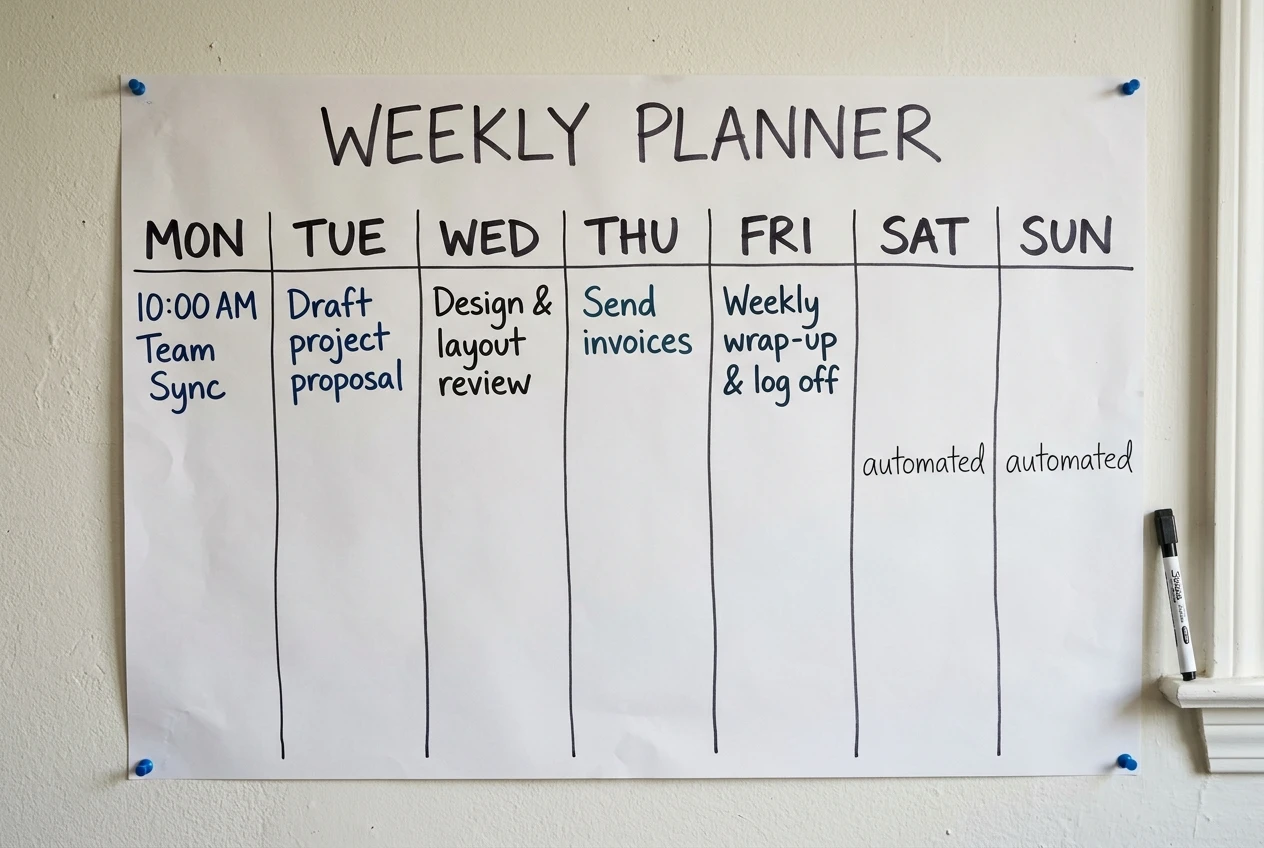
This is a starting structure, not a rule. Adjust the days to your own schedule, but keep the split between revenue and maintenance intact.
-
Monday: Research block (keywords, competitor review, program options)
-
Tuesday: Writing block, first half of the week’s content
-
Wednesday: Writing block, finish content, light editing
-
Thursday: Outreach block (partners, affiliate managers, guest opportunities)
-
Friday: Maintenance block (admin, stats review, email backlog, results check against last week’s numbers)
-
Weekend: Automated systems run; no manual work scheduled
Five days, three of them protected for revenue work, one for outreach, one for everything else. The maintenance pile still gets handled, just not at the expense of the work that actually grows income.
If your sales funnel still runs on manual follow-up, fix that leak before you rebuild your weekly schedule: automate your affiliate sales funnel so it sells.